
'The year in pictures' treks across the globe, looking back on the moments that shaped 2016. From the United States presidential race, to demonetisation in India to the refugee crisis, the news has kept pouring in. Here are our top 50 moments from the world.

Egypt's defiant Muslim Brotherhood on Thursday vowed to bring down the military-backed government as it called for a massive anti-regime rally, a day after over 525 people were killed in the deadliest crackdown by security forces on supporters of ousted President Mohammed Morsi.
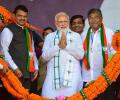
'Is Modi failing is the question which the BJP will begin to ask itself,' says Amulya Ganguli.

A summary of sports events and sports persons, who made news on Wednesday.

In its sheer audacity, the initiative with Russia has the potential to transform world politics in the same way as the 1972 Nixon visit to China and 'Shanghai Declaration' changed world dynamics, says Anil Athale.

We take a look at Time magazines top world leaders.

Google is going ahead with a policy revision mandating 30% charge on in-app purchases across all apps on Play Store. This has left developers' community worried about tighter squeeze on their earnings, says Yuvraj Malik.

The Danish Football Association (DBU) will not set aside a secure area of the national stadium in Copenhagen for groups of Serbian fans when Serbia and Denmark meets in an Euro 2016 Group I qualifier on June 13.

"A clean break from the past is essential for FIFA to climb out of the toxic pit which continues to produce serious accusations of corrupt behaviour on almost a daily basis," FIFPro said in a statement.

The ongoing corporate results and the Union budget are also making participants tread cautiously though the GST agreement provided some relief.

'The Chinese being focussed more seawards is definitely better for India with China being the looming threat along our land borders,' says Brigadier S K Chatterji (retd).

News of all that's transpired on and off the football field

'India is not so distant from years of high and entrenched inflationary expectations that it should start trying to play games with the economy the way the West's central bankers think they are entitled to,' argues Mihir S Sharma.

Allegations of predatory pricing may not hold ground in the high-pitch turf battle for consumers' pocket between e-tail and retail.

News of all that's transpired on and off the football field
Refusing to budge from its tough stand on food security issues, India pressed for a fair and balanced outcome of the WTO ministerial meeting in Bali.
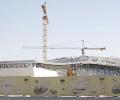
Qatar has been given two weeks to provide a report to FIFA on how it has improved working conditions for labourers in the 2022 World Cup host nation.
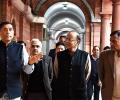
'The macro-economic stresses -- high interest rates, rupee depreciation and capital flows -- have receded now.' 'Interest rates have come down, inflation is down and the rupee has bounced back.' 'If oil prices continue at this level, there will be no vulnerability.' 'Growth is a different story.'

Lokomotiv Moscow midfielder Dmitri Tarasov insists he acted alone when he wore a T-shirt praising Russian President Vladimir Putin, leaving the player and team facing an anxious wait over possible sanctions for Tuesday's incident in Turkey.

Syriza lawmakers walked the corridors telling reporters the government might not survive the night.
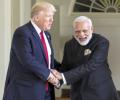
'The Modi government would chaff at the very idea of holding talks with Pakistan, facilitated by Washington and under close US monitoring, when the 2019 poll is sailing into view.' 'But in politics and diplomacy, there may be moments when drinking from the chalice of poison is necessary,' says Ambassador M K Bhadrakumar.

Amid imminent phasing out of the fiscal stimulus by US Federal Reserve, Prime Minister Manmohan Singh on Wednesday called for an "orderly exit" from unconventional monetary policies being pursued by the developed world for the last few years to avoid damaging growth prospects of the developing world.

On BSE, 1,826 shares declined and 982 shares rose, while a total of 194 shares were unchanged
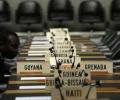
The differences between the rich and developing nations have always been at the core of the World Trade Organisation, set up in 1995 to facilitate greater trade flows across the world, and it came as a major breakthrough when the US and India reached a deal over food security issues in 2014.
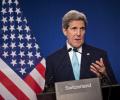
At scaling back Tehran's nuclear programme and relieving the Islamic Republic from the sanctions
 © 2026 Rediff.com - Advertise with us - Disclaimer - Privacy Policy - Sitemap - Feedback - About us - Terms of use - Grievances